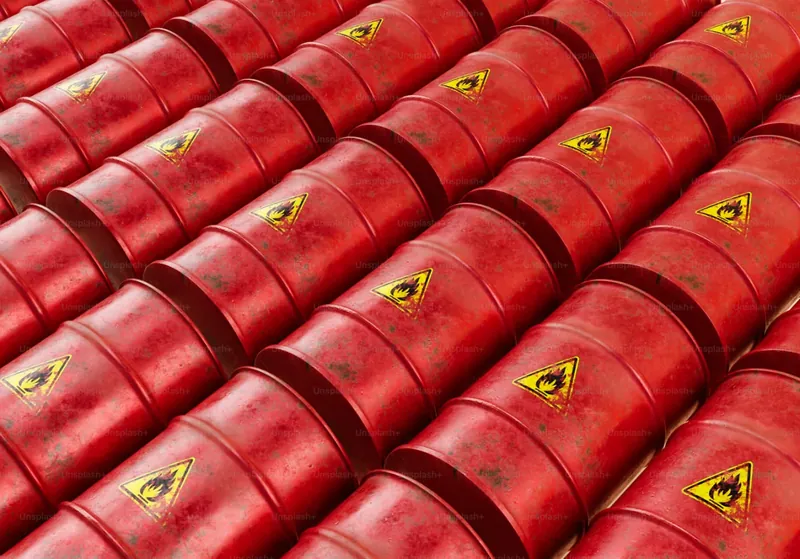

Your supplier tells you the product is "DG" or "IMO cargo": aerosols, paints, chemicals, lighters or equipment with lithium batteries. From that moment the shipment has its own rules, and several of them are best settled before you pay.
In short: to import dangerous goods to Chile you need three things in order: the classification and documents for international transport (UN number, safety data sheet, dangerous goods declaration and packaging), the Chilean health permits when the product is subject to them, and an authorized destination to store it. Few facilities accept this cargo and ports limit how long it can stay to hours or days, so pickup is planned before shipment.
What is IMO cargo and what are its 9 classes?
IMO cargo is the name given to dangerous goods regulated by the IMDG Code of the International Maritime Organization (IMO; OMI in Spanish). Since January 1, 2026, its 2024 edition (Amendment 42-24) is mandatory. For air transport, the IATA regulations apply. The code sorts goods into nine classes, according to the hazard they pose during transport.
| Class | Hazard |
|---|---|
| 1 | Explosives |
| 2 | Gases: flammable (2.1), non-flammable (2.2) and toxic (2.3) |
| 3 | Flammable liquids |
| 4 | Flammable solids, substances liable to spontaneous combustion or that react with water |
| 5 | Oxidizing substances and organic peroxides |
| 6 | Toxic and infectious substances |
| 7 | Radioactive material |
| 8 | Corrosives |
| 9 | Miscellaneous hazards, including lithium batteries |
Aerosols, for example, are identified as UN 1950 and fall in Division 2.1 or 2.2 depending on the propellant and the full formula.
What documents should you ask the supplier for before paying?
- UN number and proper shipping name (which is not the trade name), with class, subsidiary hazards and packing group.
- Safety data sheet (SDS, or HDS in Spanish). For the Chilean health procedure it must be in Spanish.
- Dangerous goods declaration signed by the shipper. By sea, the container packing certificate is added when applicable.
- Packaging that complies with the product's packing instruction, with its marks and labels.
- UN 38.3 test summary, if there are lithium batteries.
The safety data sheet does not replace the dangerous goods declaration, because they are different documents. With that information the shipping line or the airline decides whether to accept the cargo, and your customs broker (agente de aduana) checks which approval applies, as we explain in import permits.
Lithium batteries: what changed in 2026
Lithium batteries are Class 9 and their treatment depends on how they travel. By air, the IATA guidance in force since January 1, 2026 distinguishes three cases:
| How the battery travels | UN number | 2026 air rule |
|---|---|---|
| On its own (includes power banks) | UN 3480 | Cargo aircraft only. Maximum 30% state of charge |
| Packed with the equipment | UN 3481 | Maximum 30% state of charge, mandatory from 2026 for batteries over 2.7 Wh |
| Installed in the equipment | UN 3481 | 30% recommended. Not a general requirement |
The manufacturer must make the UN 38.3 test summary for the battery model available to you, so ask for it together with the quote. By sea the IMDG Code applies, and the 30% air limit does not automatically carry over to ocean transport. That is why the comparison between ocean and air freight is made with the exact product in hand.
What permits does Chile require to import dangerous goods?
For hazardous chemical substances subject to health control, the sequence has three steps. First, you obtain the Customs Destination Certificate (Certificado de Destinación Aduanera, CDA), which identifies the destination warehouse, the route and the carrier. Then the cargo is moved to that warehouse. Only then do you apply to the Regional Health Authority (Seremi de Salud) for the authorization for use and disposal (autorización de uso y disposición), with the CDA number, the invoice, the safety data sheet in Spanish and a document proving that the facility can store the product. As its name says, that authorization is what allows you to use and dispose of the goods.
Two regulations govern the Chilean leg. Supreme Decree 43 (DS 43) regulates storage: it requires a health authorization for the warehouse above 10 tons of flammables or 30 tons of other classes, and it also sets conditions below those thresholds, such as a maximum of 12 tons in a general warehouse. Supreme Decree 298 (DS 298) regulates the truck: a maximum age of 15 years, placards visible on the front, rear and sides, and a tachograph or electronic log, among other requirements. Whether your battery or aerosol needs these health permits depends on the product, so it is reviewed case by case with the customs broker before shipping.
Why are there so few approved warehouses, and what does it mean for timing and costs?
Because a facility needs more than one authorization. Besides customs approval, inside the port the Maritime Authority (Autoridad Marítima) decides, and outside the port, the Regional Health Authority under DS 43. That same decree treats containers in off-dock yards as units that are not deconsolidated, so receiving a sealed IMO container is different from opening it and storing the packages of a consolidated shipment.
At the port, dwell time is counted in hours. The authorization issued by the San Antonio Harbor Master's Office (Capitanía de Puerto de San Antonio) for the STI terminal (September 2, 2025) sets three regimes depending on the product:
- Immediate pickup: no dwell time. The cargo goes from the vessel straight to your truck, with an escort when required.
- Deferred storage: up to 24 hours, only in qualified cases and with written authorization.
- Conditional storage: up to 168 hours (7 days), with no extension.
Each terminal has its own authorization, and there is no national rule with a single time limit. In Valparaíso, for example, the procedure published by the terminal operator (consulted in October 2026) refers to 96 hours for conditional storage. This is the operator's practice and serves only as an order of magnitude, so the time limit in force is confirmed before shipping. At Santiago airport, the rule of the Directorate General of Civil Aviation (DGAC) requires dangerous goods to remain for as short a time as possible.
For your budget this means two things. The truck, the destination warehouse and the documents must be ready before the vessel arrives, because the terminal's time limit is different from the free days the shipping line gives (we explain them in demurrage and free days). And storage costs more. As an order of magnitude, the private rate sheets published in 2025 by Santiago's air cargo warehouses apply an 85% surcharge on the normal rate when the goods are dangerous: with that surcharge, a US$100 charge becomes US$185. There is no single IMO rate in Chile, which is why each operation is quoted separately.

What SICE does in this case and where its responsibility ends
SICE coordinates dangerous goods with experience in flammable gases and lighters, and stays in contact with the few warehouses in Chile approved for IMO cargo. Before shipment, it contacts your supplier and reviews the invoice, packing list, certificate of origin and transport document. Through its network it coordinates the forwarder, customs broker, domestic transport and warehouse. The classification and the dangerous goods declaration are the shipper's responsibility, acceptance of the cargo is decided by the shipping line or the airline, clearance is carried out by the customs broker, and the permits are granted by the Regional Health Authority and the Maritime Authority. SICE is not a customs agency or a shipping line. There are more details on the dangerous goods page.
Frequently asked questions
Is a power bank dangerous goods?
Yes. For transport it is classified as a lithium-ion battery (UN 3480), not as equipment.
Can I store the cargo in my own warehouse?
It depends on the quantity and the class. DS 43 treats small quantities (up to 600 kg or liters) separately, and above 10 tons of flammables or 30 of other classes it requires a health authorization for the warehouse.
How far in advance must the port be notified?
At the STI terminal in San Antonio, the information is submitted at least 24 hours before unloading. Other terminals have their own deadlines.
Does paying VAT or the tariff change because the cargo is dangerous?
Not because it is dangerous. The general rule applies: 6% ad valorem duty on the CIF value (0% with a free trade agreement, FTA or TLC, and a valid certificate of origin, depending on the product) and 19% VAT (IVA). What changes are the permits, the transport and the storage.
Official sources (in Spanish)
- IMO: IMDG Code. 2024 edition, mandatory since January 1, 2026.
- IATA: 2026 lithium battery guidance. Air rules for UN 3480 and UN 3481.
- BCN: Supreme Decree 43, storage of hazardous substances. Warehouse thresholds and conditions.
- BCN: Supreme Decree 298, transport of dangerous cargo. Truck requirements.
- ChileAtiende: use and disposal of imported hazardous chemical substances. Procedure with the Regional Health Authority.
- DIRECTEMAR: dangerous goods authorization at STI, 2025. Dwell regimes and time limits at the terminal.
If your product is dangerous goods, send us the safety data sheet and the UN number before you close the purchase. We will reply with the free complete quote: the total landed cost delivered to your warehouse, in writing, with estimated duties and VAT. You can also write to us on WhatsApp at +56 9 9872 6863.