Brazil is close enough to bring cargo by truck and far enough that the truck crosses an entire country before it reaches the Andes. That is why importing from Brazil to Chile forces you to decide two things at once: how to prove origin and which way the cargo comes.
In short: you need a certificate of origin issued by a Brazilian certifying entity to pay 0% duty instead of 6% (the 19% VAT is paid either way), the commercial invoice and packing list from your supplier, and the clearances from the Agriculture and Livestock Service (Servicio Agrícola y Ganadero, SAG) if you bring in meat, plant products or vehicles. The truck through Argentina works for urgent deliveries when the Los Libertadores Pass (Paso Los Libertadores) is open. The ship from Santos is a better fit for scheduled restocking, especially in winter.
What duty do you pay when importing from Brazil to Chile?
The preference is claimed under ACE 35 (Economic Complementation Agreement No. 35, Acuerdo de Complementación Económica), the agreement between Chile and Mercosur in force since 1996. The Chile-Brazil Free Trade Agreement, in force since January 2022, complements it with facilitation rules and sanitary measures, but the duty reduction still comes from ACE 35. With proven origin, the general 6% duty drops to 0% for almost all trade. The known exceptions are wheat, wheat flour and sugar, which carry their own levies.
The 19% VAT (IVA) still applies. With a CIF value of US$10,000, you pay US$1,900 in VAT if the certificate is valid, and US$2,614 in duty and VAT if it is not.
The Brazilian certificate of origin: who issues it and how long it lasts
The origin regime between Chile and Brazil changed on September 30, 2025, so be wary of guides published before that date. This is what applies today according to Chilean Customs (Servicio Nacional de Aduanas):
| Question | Answer |
|---|---|
| Who issues it | A certifying entity authorized in Brazil, not the supplier on its own |
| What the supplier must do | Support the application with a sworn declaration of origin |
| When it is issued | Within 180 days after the invoice date |
| How long it lasts | 12 months from issue |
| Paper or digital | The digital certificate is as valid as the paper one if authorized entities issue it |
| What if I already paid the 6% | You can request a refund within 6 months of the import, with the original certificate |
Buying in Brazil is not enough to claim the reduction, because the product must also meet the rule of origin for its tariff code. For vehicles, for example, the regime allows a general maximum of 50% non-originating materials. The full concept is in the guide on certificate of origin and 0% duty.
Truck through Argentina or ship from Santos?
There is no official transit time for either route. The times in the table are market references as of October 2026.
| Truck through Argentina | Ship from Santos | |
|---|---|---|
| Reference time | 5 to 7 days Santiago-Curitiba; 6 to 8 days Santiago-São Paulo | About 11 days of sailing to San Antonio, with departures every one or two weeks |
| Best-fit cargo | Urgent deliveries | Scheduled restocking and volume |
| Main risk | Mountain pass closure, waiting and rerouting | Missing a sailing, storage and container usage charges |
| Transport document | CRT and MIC/DTA | Bill of lading (BL) |
| Entry into Chile | Los Libertadores Pass and Los Andes Land Port (Puerto Terrestre Los Andes) | Port of San Antonio |
Note: the truck days are published for the Chile-to-Brazil direction; for the trip to Chile, ask for the transit time in writing in the quote.
The ship's transit time covers sailing only. On top of that come the transfer to the Brazilian port, the wait for the sailing and the pickup in San Antonio, where the container's free days are running.
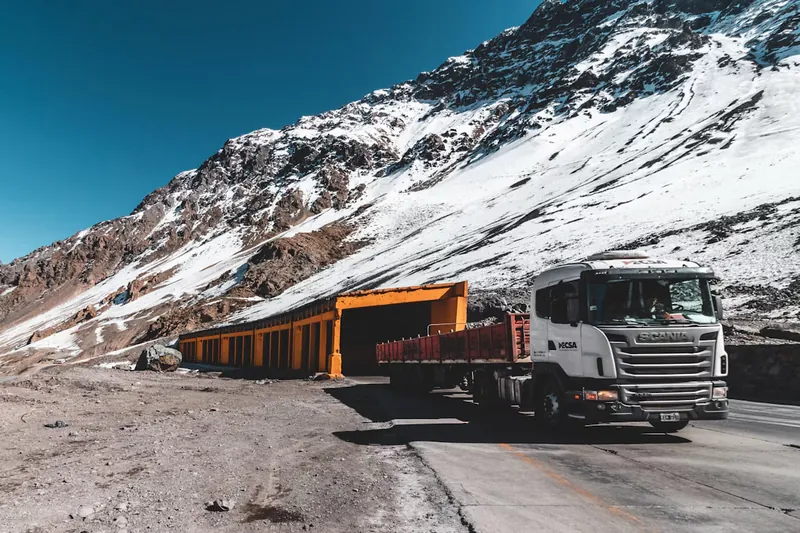
The useful comparison is factory to warehouse, with both quotes side by side. In winter the balance tips toward the ship: in August 2026 the Chilean authority reported the Los Libertadores Pass closed by snow with no reopening date, and every day a truck stands still has a cost.

What does it mean for the truck to cross Argentina in transit?
The Brazilian truck uses the same corridor and the same documents we describe in importing from Argentina by truck: the consignment note (carta de porte, CRT), which is the transport contract, and the MIC/DTA, which is the cargo manifest and customs transit declaration.
The difference is that Argentina acts as a transit country. The cargo crosses under seal and with Argentine taxes suspended, along a route and within a deadline set by that country's customs. If the mountain pass closes, someone has to request an extension of that deadline and authorize a detour through another pass. Before loading, put in writing who handles it, how much each day of waiting costs and who approves the extra cost.
The carrier's insurance does not cover the value of your cargo either. The regional agreement on carrier liability, which Chile enacted in 2001 and which Brazil also adopted, sets a maximum of US$3 per gross kilo. With that cap, a 100 kg machine worth US$30,000 would be compensated with US$300. That is why you should ask in writing for the limit that governs your transport contract and separately take out a cargo insurance policy for the real value.
What documents should the Brazilian supplier give you?
Your supplier clears the export with an electronic declaration called DU-E, which is built from the data in its nota fiscal (the Brazilian tax invoice). That nota fiscal does not replace the commercial invoice that Chilean Customs requires as the base document for the import. Ask for both, plus:
- Packing list with packages, weights and contents, which is mandatory when the cargo comes in a container.
- Certificate of origin.
- CRT if it comes by land, or bill of lading if it comes by sea.
Check that description, weights and packages match across all of them before pickup at the factory.
Meat, vehicles and plant products: SAG control
According to the official 2025 trade fact sheet on Brazil, what Chile imports most from that country is crude oil, buses, tractor units and truck chassis, fresh and frozen beef, and frozen pork and chicken.
The certificate of origin lowers the duty and the health certificate allows entry, and each one is processed separately.
- Meat and livestock products: the SAG requires the country to have been assessed for animal health, the establishment to be approved where applicable, and the cargo to arrive with the agreed health certificate. The list of approved Brazilian plants was updated in September 2026.
- Plant products: you must check the requirement by product and country, and present the phytosanitary certificate issued by the Brazilian authority. If the SAG rejects the shipment, reshipment or destruction is at the importer's expense.
- Vehicles and machinery: in 2026 the SAG issued emergency measures for new and used vehicles of any origin, and wooden packaging has its own treatment and marking requirement.
What SICE does in this case and where its responsibility ends
SICE coordinates international land transport, usually from Argentina and Brazil to Chile, and ocean freight through freight forwarders in its network. Before shipment, it contacts your supplier and reviews the invoice, packing list, certificate of origin and transport document. The import declaration is processed by a customs broker (agente de aduana) from the network, the transport is carried out by the carrier or the shipping line, and the clearances are decided by the SAG. Whether the pass is open does not depend on SICE.
Frequently asked questions
Did the Chile-Brazil Free Trade Agreement replace ACE 35?
No, it complements it. The tariff preference is still claimed under ACE 35 and its origin regime.
Is a copy of the certificate of origin acceptable?
To claim the preference when importing, Customs accepts the original or a copy. To request a refund of duty already paid, it requires the original.
Can my supplier certify origin itself?
Not yet. The new regime provides for an exporter's declaration, but it is not yet in effect.
Can I import any cut of Brazilian meat?
It depends on the species and the plant. Before buying, check with the SAG whether the establishment is approved for Chile.
Official sources (in Spanish)
- SUBREI: Chile-Brazil Free Trade Agreement: entry into force and relationship with ACE 35.
- Customs: Circular Letter 177 of 2025 and Protocol 69: current origin regime, issue and validity of the certificate.
- Customs: how much tax you pay when importing: 6% duty and 19% VAT.
- BCN: Decree 257 of 1991, International Land Transport Agreement: CRT, transit through a third country and seals.
- SAG: livestock establishments approved for import: authorized Brazilian plants.
- SUBREI: Chile-Brazil 2025 fact sheet: main imported products.
If you have a supplier in Brazil and are unsure between truck and ship, ask for the free complete quote: the total landed cost delivered to your warehouse, in writing, with firm freight, insurance, transport and fees, and estimated taxes. You can also write to us on WhatsApp at +56 9 9872 6863.