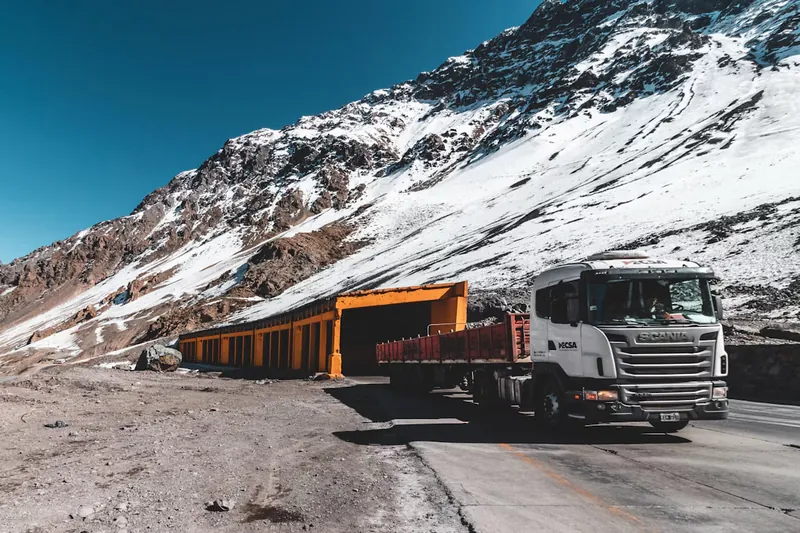

Your supplier is in Buenos Aires, Córdoba or Mendoza, and on the map it looks close. Even so, importing from Argentina to Chile overland has its own challenges: a mountain range, two customs services and documents specific to the truck.
In short: to bring cargo from Argentina to Chile by truck you need an ACE 35 certificate of origin to pay 0% duty instead of 6% (the 19% VAT is paid either way), an authorized carrier that issues the consignment note (carta de porte, CRT) and the manifest (MIC/DTA), and a customs broker (agente de aduana) to file the import declaration in Chile. With the pass open, the trip takes hours from Mendoza and a few days from Buenos Aires. The biggest risk is the closure of the Los Libertadores Pass (Paso Los Libertadores) due to snow, which is why cargo insurance and a plan B are settled before loading.
What duty do you pay when importing from Argentina to Chile?
Argentina is part of ACE 35 (Economic Complementation Agreement No. 35, Acuerdo de Complementación Económica), the agreement between Chile and Mercosur in force since 1996, and trade between the two countries has been liberalized since 2014. If the goods meet the rule of origin and arrive with their certificate, the duty drops from 6% to 0%. The 19% VAT (IVA) still applies: it is calculated on the CIF value (goods, freight and insurance), and you recover it as a tax credit if your company files VAT.
With a CIF value of US$10,000, the numbers work out like this:
- With a valid certificate of origin: duty US$0, VAT US$1,900.
- Without a certificate: duty US$600, VAT US$2,014. Total US$2,614.
The certificate is issued by a certifying entity, not by the supplier on its own, and since 2019 the two countries have used the digital certificate of origin (COD), an electronic file (XML) that is different from a scanned PDF. ACE 35 also has a new origin regime, which between Chile and Brazil has applied since September 30, 2025. Before closing the order, confirm with your customs broker whether it already applies to your Argentine purchase and which rule your tariff code requires. The details are in the guide on certificate of origin and 0% duty.
CRT and MIC/DTA: the truck documents explained simply
On the road there are two transport documents, and neither one replaces the certificate of origin or the customs declaration.
| Document | Who handles it | What it is for |
|---|---|---|
| Commercial invoice and packing list | Supplier | Support the purchase and the contents of the packages |
| Certificate of origin (ACE 35) | Certifying entity, at the supplier's request | Lets you claim 0% duty |
| CRT (international consignment note, carta de porte internacional) | Carrier | It is the transport contract for your cargo |
| MIC/DTA (cargo manifest and customs transit declaration) | Carrier | Declares to customs what the truck is carrying; each CRT is linked to one |
| DIN (Import Declaration, Declaración de Ingreso) | Customs broker in Chile | Formalizes the import and allows payment and release |
The carrier must be authorized for international transport and registered with Chilean Customs (Servicio Nacional de Aduanas). Before loading, check that description, consignee, packages and weights say the same thing in all the documents in the table. In addition, above US$1,000 FOB a customs broker is mandatory.
Where does the cargo enter, and what happens in Los Andes?
The main pass on this route is Los Libertadores, which in official notices also appears as the Cristo Redentor System (Sistema Cristo Redentor). It is the same pass: it sits at 3,220 meters above sea level and descends to Los Andes on Route 60-CH.
| Pass | Access in Chile | What the authority reported in April 2026 |
|---|---|---|
| Los Libertadores | Route 60-CH, Los Andes | All types of vehicles, 24 hours |
| Pehuenche | Route 115-CH, San Clemente | Entry into Chile from 08:00 to 18:00; confirm whether it accepts your type of truck |
| Cardenal Samoré | Route 215-CH, Osorno | All types of vehicles, 08:00 to 18:00 |
An authorized pass may be closed on the day you cross: the daily status is published by the Border Crossings Unit (Unidad de Pasos Fronterizos).
After the border, the truck reports to the Los Andes Land Port (Puerto Terrestre Los Andes), the facility where Customs, the Agriculture and Livestock Service (Servicio Agrícola y Ganadero, SAG) and the health authority (Salud) inspect cargo entering through Los Libertadores. There, the documents are reviewed, taxes are paid and, if the declaration is selected for aforo (the Customs physical inspection), the cargo is checked before release.
The SAG also inspects the packaging. If your industrial cargo comes on wooden pallets or crates more than 5 mm thick, the wood must be debarked, treated and bear the ISPM 15 mark (NIMF 15), visible on at least two sides. Without the mark, the SAG can order the packaging to be treated or destroyed.

How long does a truck take from Argentina to Santiago?
There is no official transit time. As a market reference as of October 2026, with the pass open, published times range from 2 to 5 days from Buenos Aires or Córdoba and from 8 to 12 hours from Mendoza. With an inspection, or with a queue after a reopening, the leg from Mendoza can take between 10 and 24 hours.
That range stops being useful when it snows. In 2026 the pass closed on July 14, and on August 3 the Chilean authority still reported it closed, with no reopening date; according to 2026 press figures, the closure lasted 34 days. On October 5 there was another closure, already in spring.
During the August closure, Pino Hachado, Cardenal Samoré and Jama operated with reinforced service, and the same authority warned that those passes can also close due to weather. Rerouting lengthens the journey to Santiago, so before shipping in winter, put in writing who decides on the detour and who pays the difference.
A full truck lets you set the departure date and avoid transshipments. Consolidated cargo, where you pay only for the space you take up, depends on the operator's frequency.
Why do you need insurance if the carrier is already liable?
Because the insurance that the Southern Cone land transport agreement requires of the carrier covers its own liability, which is not the same as the value of your goods.
In several countries in the region, that liability is also capped by weight. The regional agreement on carrier liability, which Chile enacted in 2001 and which Brazil also adopted, sets a maximum of US$3 per gross kilo: where it applies, a 100 kg piece of equipment worth US$30,000 is compensated with US$300. Argentina is not among the countries that adopted it, so on this route the limit depends on the transport contract, and you need to ask for it in writing before loading.
A cargo insurance policy for the real value, stating what happens in case of theft, water damage, transshipments and long waits, closes that gap. An open cover policy is useful when you bring in cargo frequently.
What changed in Argentina that affects you as a buyer?
In May 2025 Argentina eliminated export duties (retenciones) on 4,411 industrial products, which previously paid between 3% and 4.5%, and in July 2026 it announced new stepped reductions through 2027. That tax is paid by your supplier, so the reduction does not reach your invoice on its own. It does give you an argument to renegotiate the price if your product is on the list.
What SICE does in this case and where its responsibility ends
SICE coordinates international land transport, usually from Argentina and Brazil to Chile (the Brazilian truck uses this same corridor: see importing from Brazil). Before shipment, it contacts your supplier and reviews the invoice, packing list, certificate of origin and transport document. The truck is operated by the carrier, the declaration is processed by one of the customs brokers in the network, and the insurance is issued by the insurer. Whether the pass is open, and the decisions of Customs and the SAG, do not depend on SICE.
Frequently asked questions
Is the PDF certificate of origin my supplier sends me valid?
Only if it corresponds to the digital certificate, an electronic file (XML) that a scan does not replace. Your customs broker confirms it before the crossing.
What happens if the pass closes while my cargo is on the way?
The truck waits or is rerouted through another authorized pass. The costs of waiting or rerouting are split according to what was agreed with the carrier.
Do all Argentine products pay 0% duty?
Only those that meet the ACE 35 rule of origin and arrive with a valid certificate.
Official sources (in Spanish)
- SUBREI: Chile-Mercosur Agreement (ACE 35): entry into force and member countries of the agreement.
- Customs: how much tax you pay when importing: 6% duty and 19% VAT on the CIF value.
- Customs: Circular Letter 416 of 2019: digital certificate of origin between Chile and Argentina.
- Border Crossings Unit: status and hours of the border complexes: authorized passes, hours and closures.
- BCN: Decree 257 of 1991, International Land Transport Agreement: authorized companies, consignment note and carrier's insurance.
- SAG: imported wood packaging: ISPM 15 requirement for pallets and crates.
If you are evaluating an Argentine supplier, ask for the free complete quote: the total landed cost delivered to your warehouse, in writing, with firm freight, insurance, transport and fees, and estimated taxes. You can also write to us on WhatsApp at +56 9 9872 6863.